


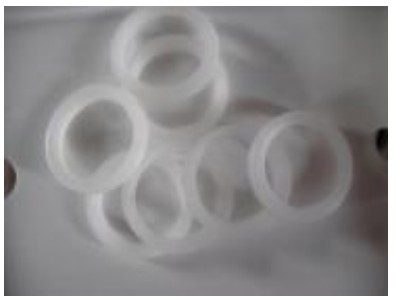
Instructions for Use:
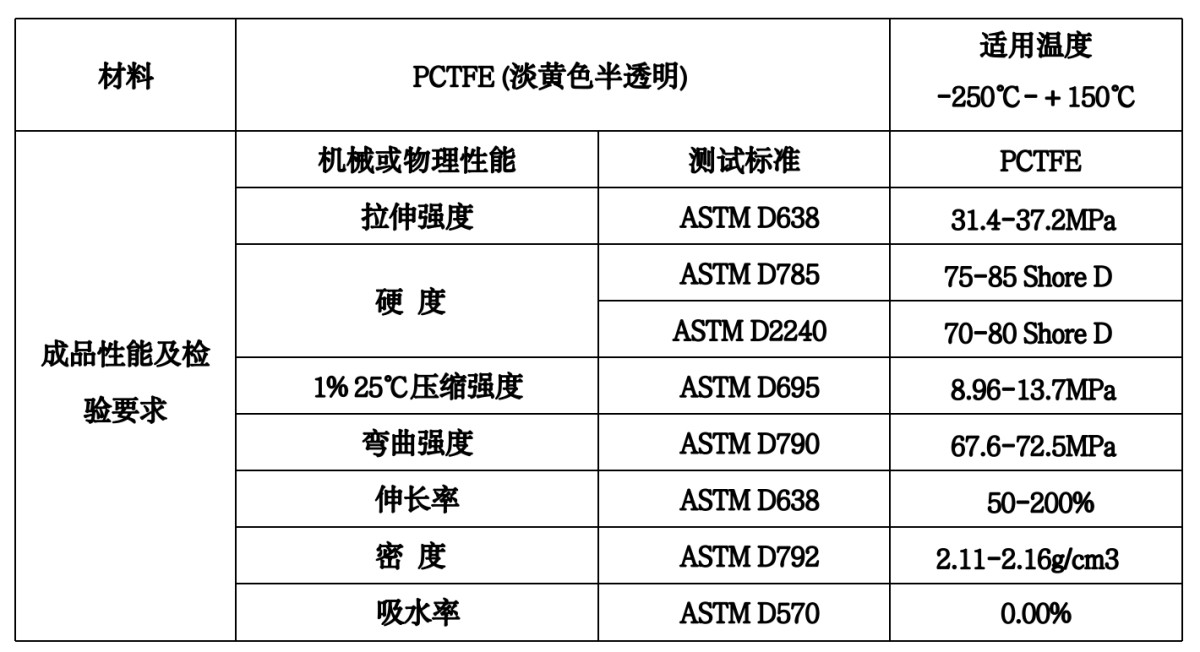
Polytrifluorochloroethylene has excellent cold resistance, high strength and hardness, good dimensional stability, and no tendency toward cold flow. Its thermal conductivity is 0.25W/(m.c), its linear expansion coefficient is (9.5-19.6)*10^-5/℃, its tensile strength is 19-20MPa, its elastic modulus is 1300MPa, its compressive strength is 50-70MPa, and its flexural strength is 70MPa. It can withstand inorganic acids at relatively high temperatures and salt-solution strong oxidants at relatively low temperatures, as well as most organic media at room temperature. The operating pressure of valves is below 25MPa.
Main Properties of PCTFE:
1. In terms of mechanical properties, PCTFE has better mechanical properties at room temperature than PTFE. It has high compressive strength, low cold flow, and a relatively high compression recovery rate, providing excellent elastic recovery.
2. PCTFE has particularly outstanding low-temperature resistance. It does not become brittle or creep in liquid nitrogen, liquid oxygen, or liquefied natural gas, and under certain conditions, it can be used at temperatures close to absolute zero (-273℃).
3. Its high fluorine content enables PCTFE to withstand almost all chemicals and oxidants. It can be immersed in acids, alkalis, or oxidants for extended periods without undergoing any change. It is only corroded by molten alkali metals, fluorine, and chlorine trifluoride at high temperatures.

Related Recommendations